Choosing a mortgage often feels like standing at a fork in the road. One path offers the quiet comfort of predictability; the other promises potential savings but demands a tolerance for uncertainty. The decision between a fixed-rate and an adjustable-rate mortgage (ARM) shapes your monthly budget, your long-term financial health, and even your peace of mind. It’s not about finding a universally “better” loan—it’s about finding the loan that fits your specific timeline and risk profile.
Before diving into the numbers, it helps to understand the core philosophy behind each option. A fixed-rate mortgage locks in your interest rate for the entire life of the loan, meaning your principal and interest payment never changes. An adjustable-rate mortgage, on the other hand, offers a lower initial rate for a set period, after which it adjusts periodically based on market indices. That initial discount can be tempting, but it comes with the question of what happens when the rate resets. This article breaks down the mechanics, the pros, and the hidden pitfalls of both so you can make an informed, confident choice.
The Basics: How Each Loan Actually Works
Many borrowers assume the difference is simply “stable vs. risky,” but the real distinction lies in how the interest is calculated over time. Understanding the mechanics prevents nasty surprises later.
Fixed-Rate Mortgages: The Predictable Classic
With a fixed-rate loan, the interest rate is set at closing and remains unchanged for the full term—typically 15, 20, or 30 years. Your monthly payment for principal and interest is calculated once and stays identical for decades. This structure makes budgeting effortless because you know exactly what your housing cost will be next year and in fifteen years.
This stability is why many homeowners, especially those planning to stay put, gravitate toward it. Even if market rates skyrocket, your payment is insulated. The trade-off is that you often pay a slightly higher initial rate compared to an ARM, and you won’t benefit automatically if market rates drop—though you could refinance to capture those savings.
Adjustable-Rate Mortgages: The Initial Discount
An ARM starts with a fixed rate for a short introductory period—commonly 3, 5, or 7 years—then adjusts annually based on a benchmark index plus a margin. For example, a 5/1 ARM offers a fixed rate for five years, then adjusts once per year. The initial rate is usually lower than a comparable fixed-rate loan, sometimes by a full percentage point or more.
After the fixed period ends, your rate can move up or down, but most loans have caps that limit how much it can change at each adjustment and over the life of the loan. These caps prevent catastrophic spikes, but they don’t eliminate the risk. If you plan to sell or refinance before the first adjustment, an ARM can be financially brilliant. If your plans change, you could face payments that increase faster than your income does.
Comparing the Real Costs: Rate vs. Payment
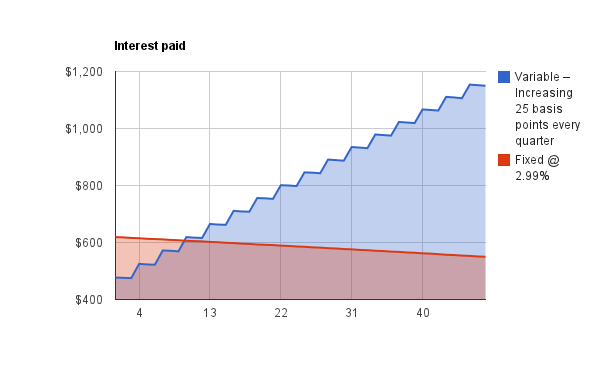
To truly compare, you must look beyond the headline rate. A lower rate on an ARM might save you money initially, but the total interest paid over time depends on how long you hold the loan and what happens to index rates.
Here is a simple breakdown of the key differences:
- Initial payments: ARMs typically offer lower monthly payments during the fixed period.
- Long-term cost: Fixed-rate loans are more expensive if rates fall, but cheaper if rates rise.
- Budget certainty: Fixed-rate wins every time for predictability.
- Flexibility: ARMs are better for short-term homeowners or those expecting higher income later.
Consider a practical example. On a $400,000 loan, a 30-year fixed at 6.5% yields a principal and interest payment of roughly $2,528. A 5/1 ARM at 5.5% would yield a payment of about $2,271—a difference of $257 per month. Over five years, that’s over $15,000 in savings. However, after the fifth year, if the index rises and your rate adjusts to 7.5%, your payment jumps to roughly $2,797. That jump could be manageable, or it could break your budget.
Who Should Choose a Fixed-Rate Mortgage?
A fixed-rate mortgage is the safer, more conservative choice, and it’s often the right call for the majority of buyers. It is ideal if you value stability over speculative savings.
You Plan to Stay Long-Term
If you intend to live in the home for more than seven to ten years, a fixed-rate loan protects you from future inflation and rising interest rates. The longer your horizon, the more valuable that protection becomes. You can build a family budget without worrying about market volatility affecting your largest monthly expense.
You Prefer Simplicity
Some people simply don’t want to monitor economic indicators. With a fixed rate, you never have to think about the Federal Reserve or the bond market again. The rate is fixed—it does not and cannot vary unless you refinance. For those who dislike financial complexity, this peace of mind is worth the extra cost.
Furthermore, if you have a tight budget or a salary that doesn’t increase significantly year over year, a fixed-rate loan prevents payment shock. The worst-case scenario is that you miss out on lower rates, but you never face a sudden increase in your housing costs.
Who Should Consider an Adjustable-Rate Mortgage?
ARMs are not inherently “bad” loans; they are simply misused by people who don’t understand the reset schedule. For the right borrower, an ARM is a strategic tool to save thousands.
You Plan to Move or Refinance Soon
If you know you’ll relocate for work, downsize, or upgrade within five to seven years, an ARM is often the cheapest way to finance that period. You benefit from the low initial rate and exit before the adjustment kicks in. Many real estate professionals use this strategy when buying a “starter home” they expect to outgrow.
You Expect Your Income to Rise
Young professionals in high-growth careers, like medicine or law, might accept a slight risk of higher payments because their earning power will likely outpace the mortgage adjustments. If you can comfortably absorb a 2% rate increase in a few years, you can pocket the initial savings now.
However, be brutally honest with yourself. The most common mistake is assuming you’ll move “in a few years” and then staying for a decade. Life changes—job transfers fall through, schools work out, family moves in. If there’s any chance you’ll stay beyond the fixed period, you need to stress-test your budget against the maximum possible payment allowed by the caps.
Market Conditions: When to Choose Which
The broader economy plays a huge role in this decision. Historically, when fixed rates are high (above 7%), ARMs become more attractive because the initial gap is wider. When fixed rates are low (below 4%), the savings from an ARM shrink, making the fixed option more appealing.
Here is a quick guide based on the current environment:
- Low fixed-rate environment: Choose fixed. The initial ARM discount is often minimal, so why take risk for a small reward?
- High fixed-rate environment: Consider an ARM if you’re confident you’ll move soon. The discount is larger and the savings more meaningful.
- Uncertain market: Look at the rate caps. If the lifetime cap is 5%, calculate whether you can afford a payment 5% higher on your current income.
It’s also worth noting that some lenders offer “convertible” ARMs, which allow you to switch to a fixed rate at a certain point without refinancing. This hybrid option can offer the best of both worlds, though it often comes with a small fee. If you’re on the fence, ask your lender if they offer this feature.
Hidden Fees and Fine Print: What to Watch For
Mortgage shopping isn’t just about the interest rate. Both loan types come with closing costs, but ARMs often have additional complexities in the fine print.
For adjustable loans, pay close attention to the adjustment caps. There are three types: the initial adjustment cap (how much the rate can change at the first reset), the subsequent adjustment cap (per year after that), and the lifetime cap (the maximum rate over the loan’s life). A common structure is 2/2/5, meaning the rate can jump 2% at the first adjustment, 2% at each subsequent adjustment, and no more than 5% over the initial rate.
Also, check the index used. Most ARMs are tied to the Secured Overnight Financing Rate (SOFR) or the Constant Maturity Treasury (CMT) rate. These indices move differently, so ask your lender which one your loan uses. The margin, which is added to the index, is fixed for the life of the loan—so negotiate that number aggressively at the start.
Finally, never forget that a mortgage is a product you can shop for. You are not required to take the first offer. Comparing quotes from three different lenders can save you thousands in upfront fees and potentially a lower margin on an ARM.
Conclusion
There is no single “right” answer in the fixed-rate vs. adjustable-rate debate—only the right answer for your life. A fixed-rate mortgage offers a fortress of predictability, making it ideal for long-term homeowners and those who value sleep-at-night security. An adjustable-rate mortgage offers a strategic entry discount, perfect for short-term owners and those with rising incomes who can absorb future adjustments.
Before you decide, take a hard look at your timeline, your job security, and your tolerance for financial volatility. Run the numbers at the maximum possible payment, not just the comfortable initial one. Whichever path you choose, understand that you can always refinance later if your circumstances change. The key is to enter the agreement with open eyes, knowing exactly what your payment will be today—and what it could be tomorrow.
Frequently Asked Questions (FAQ)
What happens to my ARM if interest rates drop after the fixed period ends?
Your rate will adjust downward in line with the index, meaning your monthly payment will decrease. However, the adjustment is limited by the caps, so it may not drop as much as the market rate does.
Can I pay off a fixed-rate mortgage early without penalty?
Most conventional fixed-rate mortgages do not have prepayment penalties, but some lenders may charge a fee if you pay off the loan within the first few years. Always read your loan estimate and closing disclosure to confirm.
Is a 5/1 ARM riskier than a 7/1 ARM?
Yes, because the fixed period is shorter. A 5/1 ARM exposes you to adjustments sooner, while a 7/1 ARM gives you two extra years of stability, often for a slightly higher initial rate.
What is the maximum my ARM rate can increase over the life of the loan?
It depends on the lifetime cap stated in your contract, typically 5% to 6% above your initial rate. For example, if you start at 5%, the rate can never exceed 10% or 11%.
Should I choose a fixed-rate mortgage if I plan to sell in three years?
Not necessarily. If you plan to sell within three years, an ARM might save you money because you will never face the rate adjustment. However, you must be certain you will indeed sell.
Can I refinance an ARM into a fixed-rate loan later?
Yes, you can refinance at any time, but you will need to qualify for a new loan based on your credit, income, and the home's equity. If rates have risen, the new fixed rate may be higher than you hoped.